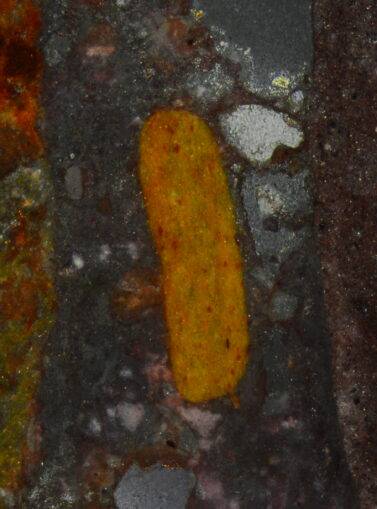
Thin-film laboratory
At TESELA, we prepare thin sections of rocks, minerals, mortars and other materials for study using transmitted-light petrographic microscopy. Careful sample preparation enables us to observe their components, textures and microstructural relationships.
This service is designed for geological, mineralogical, archaeometric, construction materials and heritage conservation studies. We tailor the sample preparation to the type of sample and the objectives of the subsequent analysis.
What is a thin sheet?
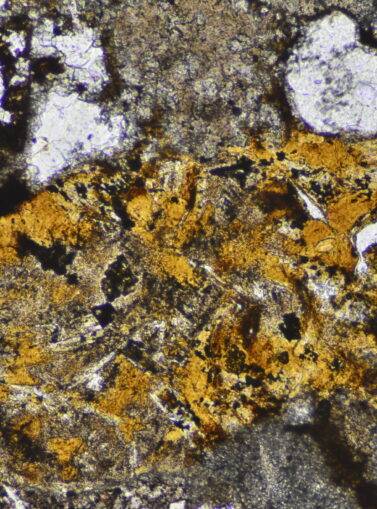
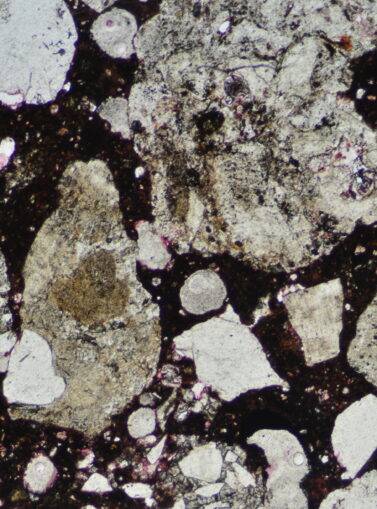
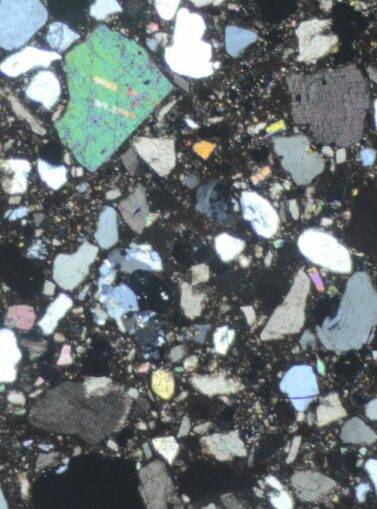
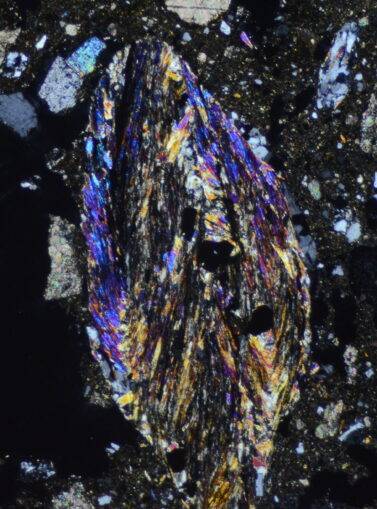
A thin section is a specimen prepared from a representative sample which is cut, mounted on a slide and ground down to a thickness of approximately 30 µm. This thickness allows light to pass through many of its components and facilitates their observation using transmitted-light petrographic microscopy.
What are thin sheets used for?
Microscopic analysis of a thin section enables the composition and microstructure of a sample to be characterised. Its main applications include:
– Identification of minerals and phases: observation of optical properties such as color, relief, birefringence, and extinction.
– Petrographic classification of rocks: study of igneous, sedimentary, and metamorphic rocks.
– Analysis of textures and microstructures: evaluation of the distribution, shape, size, and relationships among components.
– Characterization of mortars and building materials: study of aggregates, binders, pores, cracks, and other material characteristics.
– Diagnosis of alteration processes: identification of mineralogical transformations, deposits, and products of deterioration.
– Geological, archaeometric, and heritage studies: gathering information on the origin, manufacture, evolution, or state of preservation of the sample.
Who needs this service?
The preparation of thin sections can be useful for professionals, companies and organisations that need to examine materials using petrographic microscopy:
– Geologists, mineralogists, and petrographers: identification and classification of rocks, minerals, and textures.
– Laboratories and research centers: preparation of samples for scientific and technical studies.
– Construction companies and materials manufacturers: characterization of raw materials, mortars, and other products.
– Conservation, restoration, and heritage professionals: study of historical materials and alteration processes.
– Archaeologists and archaeometrists: analysis of ceramics, mortars, stone, and other archaeological materials.
– Mining companies and geological consulting firms: mineralogical characterization and evaluation of materials from deposits.
Do you need to produce thin sheets?
Please let us know the type of material, the number of samples and the purpose of the study so that we can assess the most appropriate preparation method.