


RESTORATION OF THE URDANIBIA IRONWORKS (IRÚN): CHARACTERISATION OF MATERIALS AND TREATMENTS
The Urdanibia Ironworks, situated in Irún, is one of the most notable examples of the Bidasoa region’s steel-making heritage. Documented since the 15th century and historically linked to the Urdanibia family, it formed part of a complex comprising the palace, the mill and the ironworks itself.
For centuries, these facilities harnessed the power of water to drive the machinery used in the processing and forging of iron. The site offers an insight into how economic and social activities were organised prior to industrialisation, when the stately home, iron production and agricultural activities coexisted within the same area.
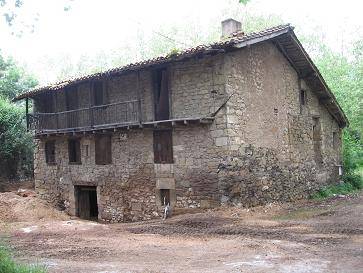
Today, the Urdanibia Ironworks retains significant historical, architectural and industrial value. Its restoration, for which Arkitektura Bulegoa S.L.P. was responsible for the design and site supervision, was supported by a scientific study carried out by TESELA to identify the building’s construction materials and evaluate different treatments aimed at improving its conservation. This is because any work on a historic building requires prior determination of the nature, composition and behaviour of its materials. This information enables the selection of solutions compatible with the original elements and reduces the risk of applying products that might alter their appearance, permeability or long-term stability.
For this reason, the study was approached from a comprehensive perspective, combining the mineralogical and petrographic characterisation of stones and mortars with laboratory tests on replacement mortars, water-repellent products and treatments to combat biodeterioration. The study included the characterisation of several replacement mortars proposed for the restoration work. These materials were analysed to compare their composition with that of the historic mortars and to assess their suitability in terms of mineralogy, petrography, water behaviour, colour and microbiology. In this way, it was possible to identify the nature of their components and verify the presence of phases, thereby providing technical criteria for selecting restoration materials compatible with the originals, both in terms of composition and physical behaviour.
The combination of analytical techniques and comparative studies makes it possible to design conservation interventions for industrial heritage that are more reliable, well-founded and respectful. In this way, materials science becomes a vital tool for conserving the Urdanibia Ironworks and preserving the historical, architectural, cultural and industrial values that form part of its identity.